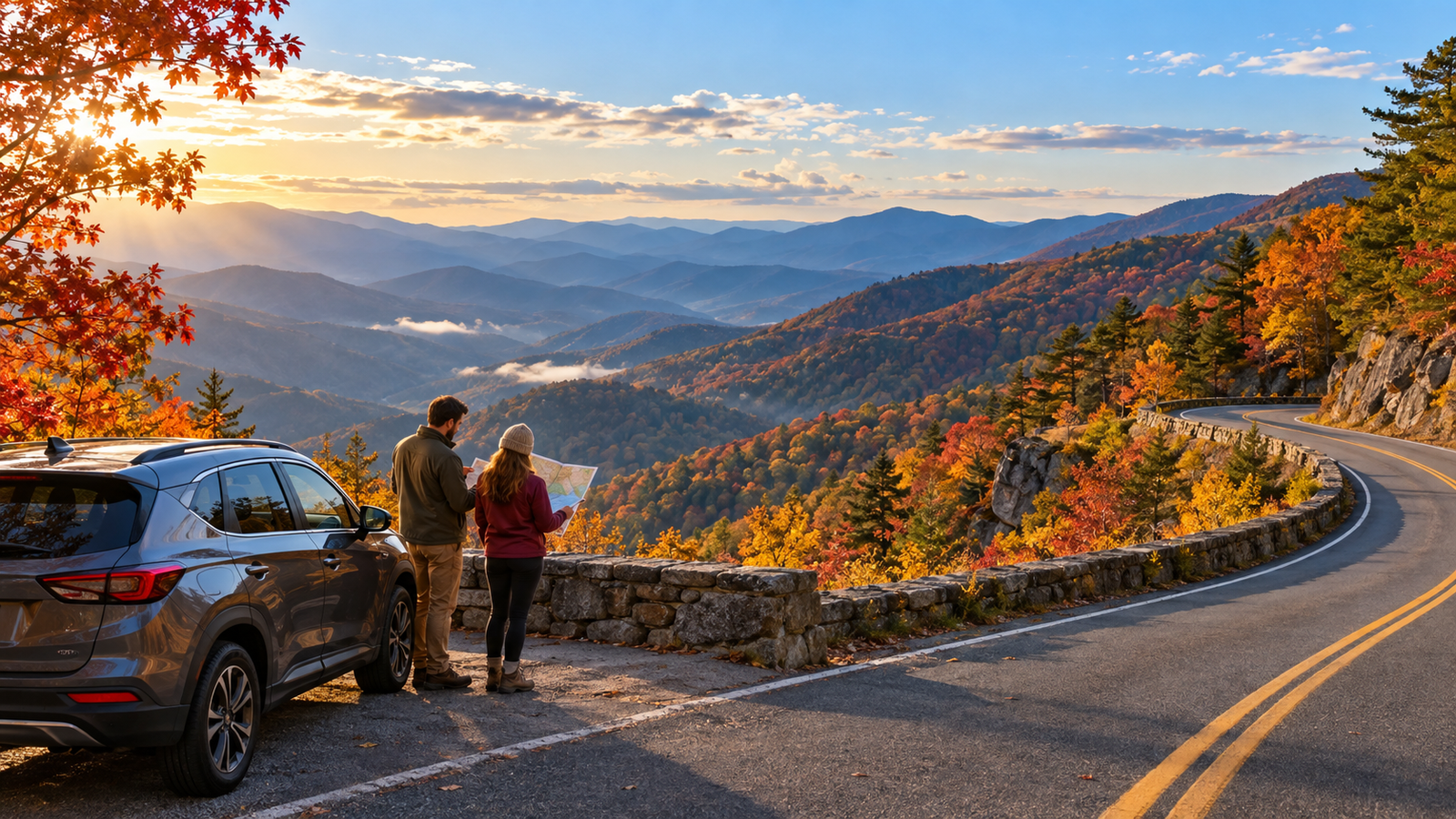
Direct answer: Do not plan a fall Blue Ridge Parkway trip as one continuous drive. Select a confirmed-open segment, identify its entrance and exit roads, and recheck the National Park Service road-status page immediately before departure.
As of the official status update on October 7, 2026, large portions of the parkway were open, but several North Carolina locations still had Helene-related restrictions. The section from NC Highway 80 to Mount Mitchell State Park was closed, with recreation prohibited inside the closure. Linville Falls Campground and its picnic area were also listed as closed. nps.gov
Choose a segment, not the entire parkway
The Blue Ridge Parkway follows the mountains for hundreds of miles through Virginia and North Carolina. A short fall visit works best when built around one accessible region.
Choose a primary entrance, two or three overlooks, and a confirmed exit. Record mileposts because they are often more useful than street addresses on parkway notices.
Avoid assuming that an open attraction means every connecting section is open. Mount Mitchell State Park, for example, may be open while a nearby parkway segment remains inaccessible.
Check the live road-status page
Parkway closures can change because of construction, storm damage, fallen trees, ice, or unsafe conditions. NPS warns that closures can happen suddenly and without notice. Blue Ridge Parkway (U.S. …
Check the status page:
- When selecting your accommodation.
- The evening before the drive.
- Again before entering the parkway.
Take screenshots of the applicable milepost section. Note the nearest numbered highway that can return you to a regular road.
Never walk, cycle, or drive around a closure barrier. “Recreation prohibited” means the closed section is not available as a quiet walking alternative.
Allow more time than the mileage suggests
The parkway is designed for scenic travel, not fast transportation. Overlooks, slower traffic, fog, wildlife, and winding roads can make a short distance take much longer than expected.
Begin with a full tank and carry water and simple food. Services on the parkway are limited and some facilities operate seasonally. Download maps before entering the mountains.
Choose only a few stops. If an overlook is crowded, continue to another safe pullout rather than parking on vegetation or along the travel lane.
Build a weather-resistant backup
Fog can erase a panoramic view, while wind and rain can make an exposed overlook uncomfortable. Select an alternative such as a nearby town, visitor center, gallery, or short lower-elevation walk.
Dress in layers because conditions change with elevation. Sunset also arrives earlier by the clock after November 1, so finish unfamiliar mountain driving before dark when possible.
Takeaway: A successful Blue Ridge Parkway drive starts with the current status map, a short confirmed-open segment, and a safe exit plan.
FAQs
Is the entire Blue Ridge Parkway open in fall 2026?
No. Access varies by section, and the official NPS page listed continuing closures in North Carolina in early October.
Can visitors walk through a closed parkway section?
Not when NPS states that recreation of any kind is prohibited. Follow the wording of the specific closure notice.
Sources: NPS current road status · NPS auto-touring guidance